
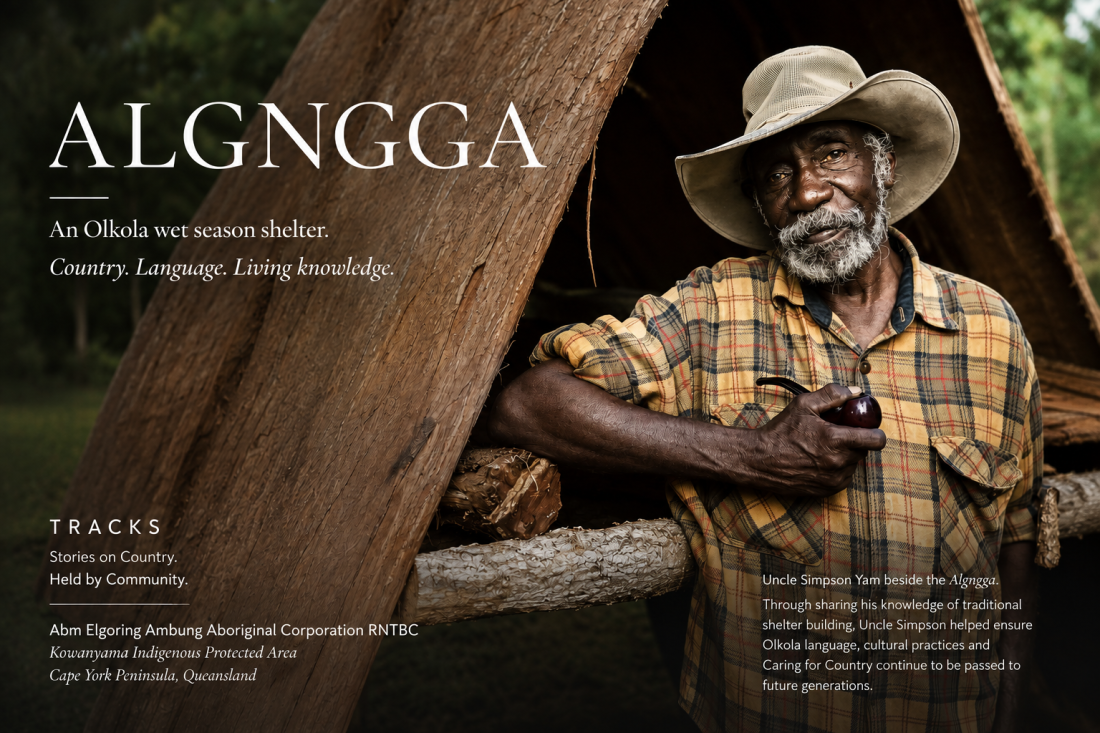
Algngga
The first sign is not the rain. It is the distant rumble of thunder rolling across western Cape York.
As the clouds gather and the first storms announce the arrival of Onyjon, the wet season, the Country begins to change. Waterholes fill, the forests come alive and the bark of the Ug athar, the messmate tree, begins to loosen. For generations, these were the signs that told Olkola families it was time to prepare for the months ahead.
It was time to build an Algngga. Watch the BushTV short documentary produced with and for Kowanyama Elders.
At first glance, an Algngga appears to be a simple raised bark shelter.
In reality, it represents thousands of years of accumulated knowledge. Every timber post, every sheet of Algnggar (messmate bark), every angle of the roof and every decision about where and when to build reflects an intimate understanding of Country that has been refined over countless generations.
Recently, that knowledge was brought back to life in Kowanyama, where Olkola Elders and younger community members worked together to rebuild an Algngga. The project was far more than the construction of a traditional shelter. It became an opportunity to reconnect with language, share cultural knowledge and ensure important skills continue to be passed to future generations.
Building an Algngga begins long before the first post is placed in the ground.
It begins with knowing Country.
The right Ug athar trees must be selected. Their trunks need to be straight and free from knots so the bark can be removed in long waterproof sheets. The timing is equally important. The bark can only be harvested successfully when the wet season begins and the tree naturally loosens its grip.
The bark itself tells another story.
Freshly removed, the curved sheets of Algnggar are carefully warmed over fire until they soften and can be flattened without splitting. Every step requires patience, skill and experience learned by working alongside Elders.
The design of the shelter reveals a deep understanding of the local environment.
Unlike many coastal shelters, the Algngga is built high above the ground. During Onyjon, western Olkola Country becomes waterlogged and difficult to move through. The raised Ug ator, the sleeping platform, keeps families above the flooded ground, while a fire beneath provides warmth and fills the shelter with smoke, helping protect people from Ogngol (mosquitoes) and Eran (sandflies). Every feature exists for a reason. Nothing is accidental.
Perhaps the most remarkable part of the project was not the shelter itself.
It was the conversations taking place around it.
As younger people worked, Elders shared stories, corrected techniques, explained why posts needed to be buried deeper, why the roof should sit lower, and how their parents and grandparents had built Algngga across the forests of western Cape York. Language was spoken naturally as knowledge was passed from one generation to the next.
This is what Caring for Country looks like.
When many people hear the words Indigenous Protected Area, they think of conservation projects, threatened species or fire management.
Those things are all important.
But Indigenous Protected Areas also protect something far less visible.
They create opportunities for Traditional Owners to return to Country, for Elders to teach young people, for language to be spoken, and for ancient knowledge to remain alive through practice rather than memory alone.
The rebuilding of the Algngga is a powerful example of that living conservation.
It demonstrates that caring for Country is about more than protecting landscapes. It is about protecting the knowledge that belongs to those landscapes. The seasons, the trees, the language, the stories and the skills are all connected.
Across Australia, Indigenous Protected Areas are making this possible every day.
Some projects restore wetlands. Others protect endangered species or use cultural fire to reduce the risk of destructive bushfires.
Here in Kowanyama, an Algngga stands once again.
Not as a relic of the past.
But as a living classroom.
A place where Orrngan—the Olkola concept of making, building and creating—continues.
And with every generation that learns these skills on Country, the knowledge that shaped the Algngga continues to shape the future. Watch the stunning short documentary produced by BushTV with Uncle Viv and Kowanyama Elders.
No Comments